
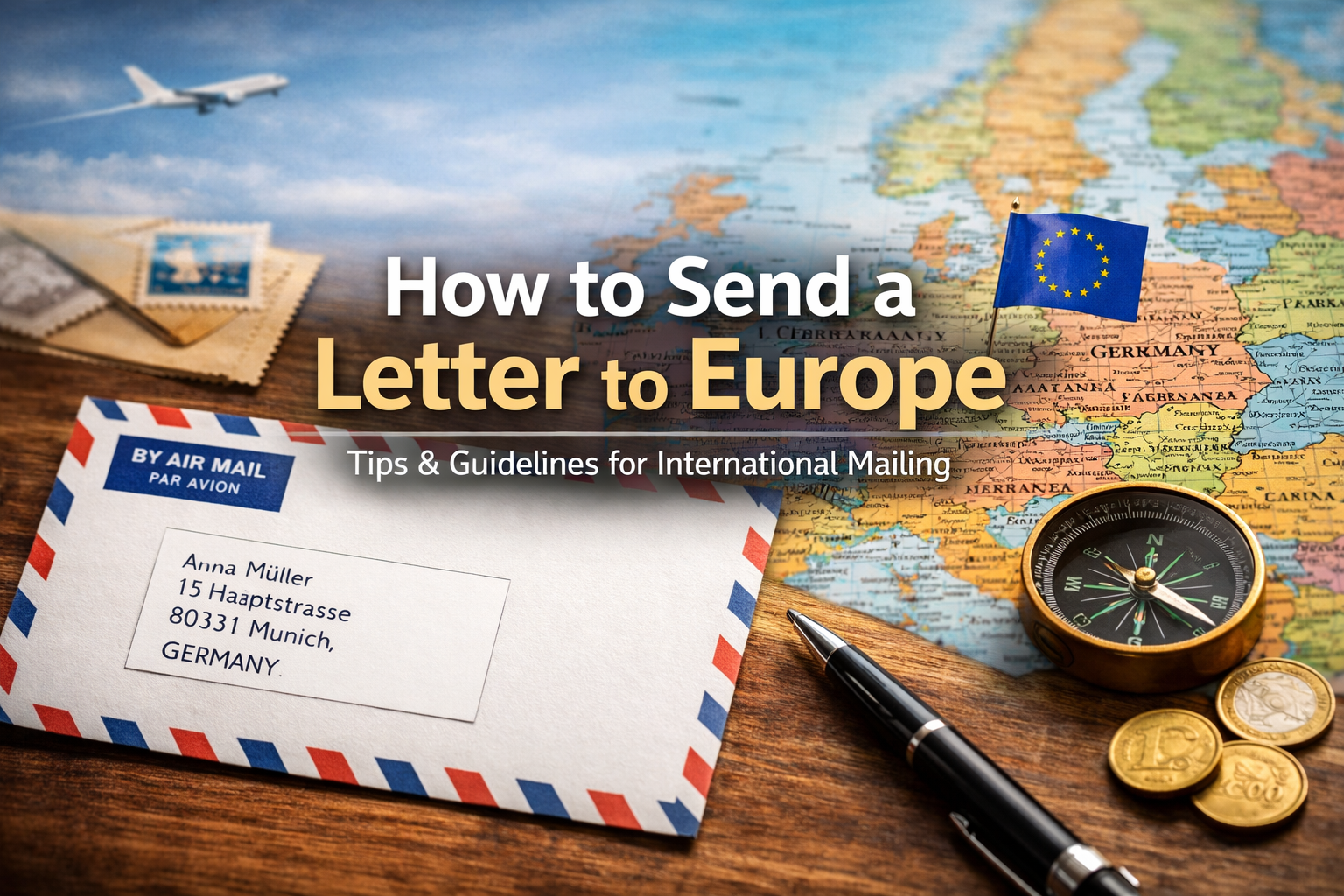
Sending a letter to Europe is still important for many personal and business situations.
People still post letters to European countries for signed documents, contracts, formal notices, invoices, application paperwork, customer correspondence, and personal communication that needs to feel more official. Physical mail can also be easier to retain, file, and take seriously than email. Royal Mail’s international services for Europe typically publish delivery aims from 3 to 5 working days, depending on service type.
This guide explains when sending a letter to Europe makes sense, how to address it properly, what mistakes to avoid, and how to make the process easier.
Why would someone send a letter to Europe?
People send letters to Europe for many practical reasons.
A business may need to send a contract, invoice, signed letter, complaint response, compliance document, or account paperwork. An individual may need to send identity documents, declarations, supporting forms, legal correspondence, or a personal letter that carries more weight than an email.
In many cases, a physical letter is useful because it feels more formal, more deliberate, and easier for the recipient to recognise as important. That is especially true for official communication, customer correspondence, and paperwork that may need to be printed, signed, or stored.
When is a physical letter better than email?
A physical letter is often better than email when the communication needs to feel formal or difficult to ignore.
That can include:
- business correspondence
- signed or printed documents
- complaint letters
- legal or administrative notices
- paperwork for landlords, tenants, employers, or suppliers
- customer communication where presentation matters
Email is fast, but it can be buried in a crowded inbox or filtered out. A posted letter often feels more intentional and more credible.
How do you address a letter to Europe?
The most important rule is to write the address clearly, fully, and in the format expected by the destination country where possible.
For international items, Royal Mail says the country name should be written on the last line in capital letters. UPU guidance says the destination country must be on the last line, in full, preferably in capital letters, and that international addresses should be written legibly in Roman letters and Arabic numerals.
A typical format is:
Recipient Name
Building number and street name
Apartment, suite, or unit if needed
Postcode and town/city
COUNTRY
For example:
Maria Jensen
12 Example Street
Apartment 4
2100 Copenhagen
DENMARK
What is the correct international address format?
The correct format depends partly on the destination country, but some rules are widely consistent.
The destination country should appear on the final line in capitals. The rest of the address should follow the local convention of the country receiving the item. UPU guidance specifically says that, for international items, the country line is dictated by the country of origin, while the rest of the address should follow the practices of the destination country.
That means it is a good idea to use the local country format where possible.
For example, Royal Mail’s Germany guide says the house number should come after the street name, and the five-digit postcode should come before the town name.
What are the best tips for sending a letter to Europe?
Here are some of the most useful tips:
1. Use the recipient’s full name
Always use the full name of the person or business receiving the letter.
2. Include the complete address
Do not leave out apartment numbers, suite references, building names, district information, or postcodes.
3. Put the country on the last line
Write the destination country clearly on the final line in capital letters. This is standard international guidance.
4. Follow the destination country’s local format
If the recipient has provided their address in a certain format, keep it that way where possible.
5. Use clear text
International addresses should be legible and should preferably use Roman letters and Arabic numerals.
6. Check the postcode carefully
A wrong postcode can delay or prevent delivery.
7. Review enclosed documents
If the letter contains supporting pages, signed documents, or forms, check that everything is included before sending.
8. Allow enough time
Royal Mail’s Europe services often publish delivery aims around 3 to 5 working days, but those are aims rather than guarantees.
What mistakes should you avoid when sending a letter to Europe?
The most common mistakes are simple ones.
These include:
- missing flat or apartment numbers
- incorrect postcode
- misspelt town or street names
- forgetting the country line
- putting the country in the wrong place
- rewriting the address into a format that does not match the destination country
- unclear handwriting
- forgetting to include all pages or attachments
Some countries are stricter than others. For example, Royal Mail’s Germany guide notes that incorrectly written addresses may result in the item being returned without a delivery attempt.
How should you write a formal letter to a European recipient?
A formal international letter should be clear, professional, and easy to understand.
State the purpose of the letter early. Keep paragraphs short. Include dates, references, and names where relevant. If documents are enclosed, say so in the letter. If the issue is important, keep a copy for your own records.
This is especially useful for customer communication, invoices, formal notices, business relationships, and legal or administrative matters.
Why does printed correspondence still matter?
Printed correspondence still matters because it creates presence.
A physical letter often feels more serious than email. It can improve presentation, support a more professional image, and make the communication easier for the recipient to retain and file.
For small businesses, that can help reinforce trust and brand credibility. For individuals, it can make important communication feel more deliberate and more personal.
Is there an easy way to send a letter to Europe online?
Yes. Many people now look for ways to send letters without printing at home or visiting a Post Office.
That is where SendDoc fits naturally into the process.
If you already have a document ready, SendDoc makes it easier to send letters to European recipients online. Instead of handling the printing and posting yourself, you can prepare the document digitally and use SendDoc to simplify the process.
That means the customer still benefits from all the best practices above — clear addressing, complete information, and professional presentation — without the usual inconvenience.
Final thoughts
Sending a letter to Europe is still useful for business, official, and personal communication.
The key steps are simple: write the address clearly, follow the destination country’s format where possible, include the country on the final line in capitals, double-check the postcode, and review all documents before sending. Royal Mail and UPU guidance are both consistent on the importance of clear international addressing and correct country placement.
If you want a more convenient way to send important post abroad, SendDoc now lets users send letters to Europe online.