
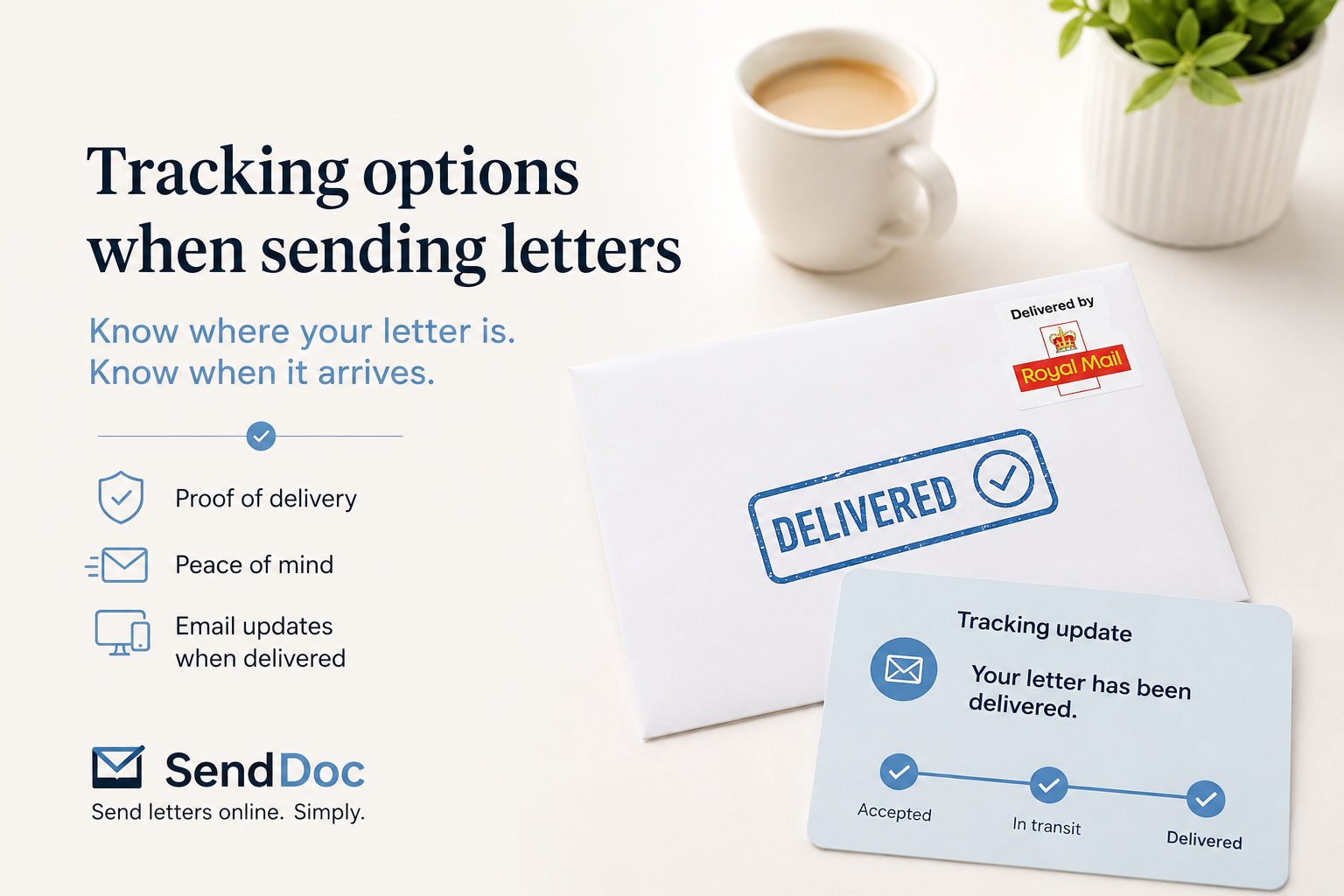
Sending a letter may seem simple: write it, post it, and wait. But when that letter contains something important, proof of delivery can matter just as much as the message itself.
That is where letter tracking comes in. Whether you are sending legal notices, invoices, contracts, customer documents, official forms, or time-sensitive correspondence, tracking gives you a clearer record of where your letter is and whether it has been delivered.
For businesses and individuals using Royal Mail, tracked and signed-for services provide extra confidence compared with standard post.
What is letter tracking?
Letter tracking is a delivery service that gives the sender visibility over the progress or delivery status of a letter.
Depending on the Royal Mail service used, tracking may include:
- A tracking or reference number
- Online delivery confirmation
- Signature on delivery
- Proof that the letter reached the recipient address
- Delivery updates by email or through a tracking page
- Compensation cover, depending on the service
Royal Mail’s tracking services are designed to give senders more visibility and confidence when posting important items. Rather than simply sending a letter and hoping it arrives, tracking provides a record that can be checked after posting.
Why is tracking necessary?
Not every letter needs tracking. A birthday card, general update, or low-value personal note may not justify using a tracked option.
But for important letters, tracking can provide three major benefits.
1. Proof of delivery
If you are sending a document that may later be disputed, delivery confirmation can be useful. This is especially relevant for legal letters, business notices, contracts, tenancy documents, complaint letters, account closure requests, or formal correspondence.
Tracking helps answer the question: “Was the letter delivered?”
2. Peace of mind
When a document matters, uncertainty is frustrating. A tracking update gives the sender and recipient more confidence that the letter is moving through the postal system.
3. Better customer communication
For businesses, tracking is also part of customer service. If you send documents to customers, clients, suppliers, or employees, being able to confirm delivery reduces follow-up emails and improves trust.
A brief history of Royal Mail and tracked delivery
Royal Mail has a long history as one of the world’s oldest postal services. Its roots go back to the early 16th century, and over time the UK postal system became central to personal, commercial, and government communication.
One of the biggest milestones in British postal history was the introduction of the Uniform Penny Post in 1840, which helped make letter sending more affordable and accessible to the public. Since then, postal services have continued to evolve from simple letter delivery into more advanced services offering speed, security, signatures, and delivery confirmation.
The idea of paying extra for more secure or confirmed delivery is not new. Royal Mail has long offered premium services for valuable, urgent, or important items, including registered, recorded, signed-for, and special delivery options.
What has changed is technology. In the past, proof of delivery depended on paper receipts, manual records, and physical signatures. Today, barcodes, online tracking pages, email notifications, and digital delivery confirmation make it easier to follow a letter’s journey and prove that it arrived.
Royal Mail tracking options for letters
For UK letters, the most common Royal Mail options include standard post, Signed For, and Special Delivery.
Standard 1st Class or 2nd Class
Standard post is suitable for everyday letters where proof of delivery is not essential. It is commonly used for general correspondence, personal letters, simple notices, and non-urgent documents.
However, standard post usually does not provide the same level of delivery visibility as tracked or signed-for services.
Royal Mail Signed For
Royal Mail Signed For is useful when you want confirmation that your letter has been delivered. Depending on the service selected, it may include online delivery confirmation and a signature on delivery.
This is a good option when you do not necessarily need the fastest or most secure service, but you do want evidence that the letter reached its destination.
Royal Mail Special Delivery Guaranteed
Special Delivery is generally the stronger option when timing, security, or compensation matters. It is commonly used for highly important, urgent, or sensitive documents.
This may be suitable for passports, legal papers, court documents, urgent contracts, or documents with financial or personal value.
What types of letters should use tracking?
Tracking is advisable when the consequence of losing the letter, delaying it, or being unable to prove delivery is greater than the added postage cost.
You should consider tracked or signed delivery for:
- Legal letters and notices
- Contracts and signed agreements
- Tenancy or property documents
- Invoices, payment demands, and debt-related letters
- Complaint letters and formal disputes
- HR letters, employment documents, and termination notices
- Medical, insurance, or financial correspondence
- Documents sent to government bodies
- Customer documents where delivery confirmation improves service
- Any letter where you may later need evidence that it was sent or received
For casual letters, greetings cards, marketing letters, or low-risk communications, standard post may be enough.
Is tracking worth the added cost?
The value of tracking depends on the importance of the letter.
For an ordinary note, standard post may be perfectly suitable. But for a legal notice, signed contract, invoice, customer document, or formal complaint, the extra cost of tracking is often small compared with the risk of not knowing whether the letter arrived.
A useful rule is:
If the letter could cause a dispute, delay, financial loss, customer complaint, or compliance issue if it goes missing, use tracking.
Tracking is not only about delivery. It is about confidence, accountability, and having a record when it matters.
SendDoc now supports Royal Mail tracking updates
SendDoc already makes it easy to send letters online without printing, posting, or visiting a post office.
Now, SendDoc also offers tracking options for customers who want extra visibility when sending important letters.
Even better, we have added a new feature that allows Royal Mail tracking updates to be sent directly to the customer-designated email address. This means the sender, or the recipient email entered during the SendDoc process, can receive delivery updates directly from Royal Mail.
So when your letter is delivered, the right person can be notified.
This is another reason to send letters with SendDoc: you can prepare, send, and track important letters more easily, all from one online process.
Final thoughts
Letter tracking is not necessary for every piece of post. But when you are sending something important, the extra visibility can be well worth it.
Royal Mail tracking and signed-for services help provide delivery confirmation, reduce uncertainty, and create a stronger record for important correspondence. With SendDoc’s tracking options and direct Royal Mail email updates, sending tracked letters is now even easier.
Whether you are sending business letters, legal documents, customer notices, contracts, invoices, or official correspondence, SendDoc gives you a smarter way to send letters online.
Send your next important letter with SendDoc — and choose tracking when delivery matters.